On Tuesday, March 9, members of the Arden’s board and Sylvan Society were invited to learn stage combat from members of the Romeo and Juliet cast. Watch this video to see how our supporters learned to slap, punch and choke just like professional actors. We finished the evening with a backstage tour to share secrets behind Romeo and Juliet. Thanks to all those that participated!
Romeo and Juliet Fight Night with Arden’s Sylvan Society
March 10th, 2010Romeo and Juliet Young Friends Night
March 10th, 2010On Friday, March 5 we hosted a Young Friends of the Arden night at Romeo and Juliet. Our neighborhood dining partner QBBQ + Tequila brought over some tasty tacos, sliders, and chips and salsa as well as margarita samplings for everyone to enjoy before the play. After watching the show, the Romeo and Juliet cast joined us over at QBBQ for a special happy hour and plenty of dancing!
Here are some photos from the pre-show party at the Arden.
Thanks to all those that attended!
Be sure to save the date for the final Young Friends event of the season: Sunday in the Park with George on Friday, June 4!
What audiences are saying about Blue Door
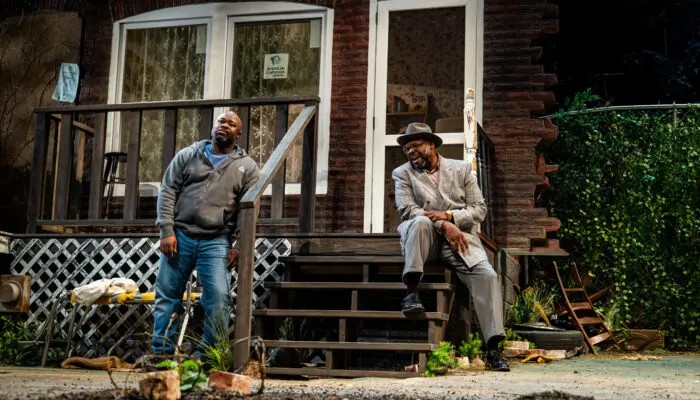
March 8th, 2010Blue Door has been sparking conversation. Here’s a short video where we caught up with some audience members after the show to see what they thought!
Here are some other thoughts that audiences shared with us via email.
My niece and I enjoyed Blue Door. We cried, laughed and reflected.
She is learning about African American History in school and she said
on the car ride home: Wow Auntie I wish my whole class could see Blue
Door. - Jamie
I enjoyed the production VERY much. As usual,the acting at the Arden was excellent. The story was interesting to me as I lived through many of these years (I was born in 1933). The storyline intertwining the black history of a family and the current crises facing a successful, educated black man at present in our “tolerant” world today were both treated with passion and empathy for the roles of each. -Rhoda
Blue Door was a haunting, powerfully acted, and moving play. It was amazing. -Sue
I thought the play was amazing as were the two actors. They had a lot to say of importance. Walking in someone else’s shoes makes for fascinating discoveries. -Lois
Blue Door was done extremely well – and what a difficult play it must have been to write (and perform). My wife and I (we’re old folks) were reminded of how very very far American society has come in just our short lifetimes. -Deane and Francoise
I will try to tell you how much we loved the play. How moved we were. How we couldn’t possibly have pulled it together at the end of the play to applaud out the honor the actors, and director, and playwright and the Arden, for presenting such a beautiful, moving, professional’s professional production. -Laura
Being now a grandmother of five, it’s always a delightful surprise to suddenly see in one of them a familiar expression, habit or talent that reminds me of my own parents…and that’s when you realize how connected it all is. -Terry
What conversation did Blue Door inspire for you? Leave us a comment!
Opening Night of Romeo and Juliet
March 5th, 2010We opened Shakespeare’s Romeo and Juliet on Wednesday, March 3. Our Sylvan Society members attended a pre-show party at GiGi Restaurant and Lounge in Old City. Following the performance, guests mingled with with the cast and creative team. Romeo and Juliet runs through April 11.
Here are some photos from the evening!
Season Planning 3 – Old and New
March 3rd, 2010By Ed Sobel, Associate Artistic Director
Quite understandably, very few of the season suggestions we received were brand new plays that had not yet been performed elsewhere. One of the frequent debates heard in season planning meetings is about the amount of new work present in a season. Those of you who followed my recent conversation with Terry Teachout on the issue know that the question pervades beyond the small confines of an artistic office at a regional theatre. The conventional wisdom, Mr. Teachout’s assertions aside, is that new work must make up a small minority of the programming if a company is to maintain fiscal health. New work is viewed as “risky” and is administered in a season to audiences like medicine – with a spoonful of sugary known quantities and familiar titles.
But when you actually do some empirical digging (through market research, etc.), you find that most audiences don’t care if something is new, they just care if it is good. I put it that if you ask almost anyone, they’d rather see a good new play than a bad production of A View From the Bridge.
The real question is what will vouchsafe the experience for the audience, so that they have confidence they are more likely to see something good and not bad. Sometimes it is the known title of the play or the reputation of the writer. Sometimes it is the quality of the acting, or a particular actor (hence the rise of star casting in the commercial theater – “Even if I don’t like the play, I still got to see Nicole Kidman/Daniel Craig/Denzel Washington”), or the director. At the Arden, we try to make it the whole experience; from the moment of our first contact together through attending a production, and after.
This means approaching our relationship with our audiences not as purely transactional (pay good money, get a production in return) but as more holistic and deeper. The most important relationships in our lives are not reductively transactional; our job, our family, our education, our community or neighborhood, our spiritual or religious belief.
Most of the time, when we have a bad day at the office, we don’t quit. When we have an argument with our spouse or parents or children we don’t storm out of the house never to return. If we take one bad class in a university we don’t drop out of school. If our neighbor doesn’t shovel his/her walkway, we don’t sell our home and move across town.
Those relationships are built upon greater shared values, and upon a level of trust that is built over time. That is the kind of relationship we endeavor to have with our audience. It has to be our task to select a season that demonstrates, and sometimes leads, the shared values of our audience and that validates the trust placed in us.
In our 2010-11 season, you will see a slate of plays each of which in some way exemplifies our trust in you, and yours in us. One or two may be from a playwright whose work you know and admire, one or two may be lead by a director whom you trust to create a meaningful experience, and one or two may be completely unfamiliar. For those, we are seeking your trust in your experience with us, and we will do our dedicated best not to let you down.
Giving the Play-by-Play
March 2nd, 2010By Matt Ocks, Manager of Institutional Giving
At the Arden we’re having conversations about how best to engage you – the audience – in new work. (You may not know it, but you are experiencing one of our methods right now, just by reading this blog entry. To paraphrase Dirty Harry – You’ve got to ask yourself one question. Do I feel engaged? Well do ya?) Anyway…
I’m a lifelong theatre buff, thanks in large part to my mother’s perhaps odd decision to take me to Into the Woods on Broadway when I was 5 (Turns out the whole thing is about sex and death. Who’d a thunk it?). Having now worked in development and stage management, not to mention as a writer, actor, assistant director, house manager, curtain speech giver, coffee fetcher, and teaching artist — I can honestly say that a lot of the things that first dazzled me about the theatre – like the giant head and the fake white cow – have now been demystified.
And as I listen to my colleagues debate ways to make the theatrical process more transparent, I tend to get anxious. Isn’t part of the joy of being an audience member not knowing how we did it? Are we depriving people of the mystery and intrigue of theatre by revealing too many of our secrets?
Arden Children’s Theatre is a great example. As many of you know, each show ends with a Q and A session where kids get to ask the actors how they did things in the show. It’s inspiring to see so many kids with their hands raised. But I think about when I was a kid. I would come home after seeing a play and spend hours trying to figure out how they had achieved various effects. I had construction paper and crayons and action figures and models. Going to plays sparked my imagination. If I had seen through the smoke and mirrors then, I might not be such a theatre guy now.
Or maybe I was just weird as a kid.
Strike that.
I was weird.
And the truth – as Ed Sobel pointed out to me not too long ago – is that a more informed audience is a more passionate audience. To illustrate his point, Ed spoke about art museums. A person gets more out of the experience of going to an exhibit if he/she took an art history course in college or a drawing course when they were a kid.
Having given this some serious thought, I would make the same point in another way. If you’re watching a baseball game, and you’ve never played baseball or you have no idea about the rules of the game, it’s probably going to be a pretty boring experience. But if you’re an informed fan – if you can tell the difference between a knuckle ball and a curve ball, a fast ball and a slider – you’re gonna find even the most uneventful pitchers’ duel more interesting.
The great thing about baseball is everybody’s an expert. Those of us who watch the game know all about Chase Utley’s batting stance, Placido Polanco’s throwing arm (let’s hope he’s still got it!), and Jimmy Rollins’ stealing ability. When the Phillies make a trade that many of us disagree with (Ahem. Cliff Lee), we can talk about why this was a mistake intelligently. Because we are informed.
Which brings me to my next point. You see, dear readers, I, Matt Ocks, have finally figured out the best way to keep you, me, all of us engaged by the theatre:
Sportscasters.
Okay. Not actual sportscasters. But people who serve the same role in our field that Cris Collinsworth and Mary Carillo serve in the Olympics. They keep us informed about how athletes prepare for each event, what they are going to be judged on, and – later – how well they did. If it wasn’t for this kind of coverage, I’m not sure how much I would have gotten out of curling the other night.
And I think maybe it does need to work the same way in theatre. To appreciate – even to criticize – acting, for instance, you should know about how much work goes into crafting a performance; you should know what an objective is, what specificity does, etc. The same goes for writing, designing and directing. If you guys all knew as much about the process as we do, you’d be better judges not only of whether or not you like a play, but why you like or don’t like it. In the same way that you can only get excited about Roy Halladay joiing the team if you understand the art of pitching and what it means for the Phillies to have him. And how incredible it would have been to have him and Cliff Lee and…oh, never mind.
One final point about sportscasters: I purposely chose Cris and Mary as my examples over, say, Al Michaels and Bob Costas, because they are not only sportscasters but people who played professional sports. I don’t think that our “theatrecasters” can only be dramaturgs and arts journalists – people whose job it is to communicate what we do to the public. I think actors, writers, directors and designers should also play a part in analyzing the work of their peers, giving the “play by play” so to speak. After all, no one else knows better what it’s like to put everything on the line, on stage, in front of a dark room full of strangers. No one else is better equipped to judge failure, success and everything in between.
At least in my opinion. Others may (and probably do) disagree. I also wonder – if you do agree with me – if you have any thoughts on how active and former theatre artists could play a larger role in “covering” theatre the way Scott Hamilton covers figure skating.
I welcome any response you may have to this in the comments section.
And that includes commiserating over the loss of Cliff Lee. Did Ruben Amaro watch the world series?!!
Sheesh.
Season Planning — An Economics Lesson
February 25th, 2010By Ed Sobel, Associate Artistic Director
First, please accept my thanks to all who have posted comments and suggestions thus far. As promised, I am going to respond to some of these, with an eye toward illustrating some of the process and issues we face when putting together the season.
One of our season planners was kind enough to suggest the Jez Butterworth play Jerusalem. Jez Butterworth is a British writer who, at the ripe old age of 25, became the toast of London theater when the Royal Court produced his play Mojo back in 1995. He then devoted time to making the movie of that play, and several other movies (The Birthday Girl with Nicole Kidman, e.g) and it was seven years before he returned to writing plays including The Night Heron, and now Jerusalem. Jerusalem, like Mojo, has created quite a stir in London, and is scheduled to have a commercial run there shortly. So, as our planner noted, there are likely to be some issues with obtaining performance rights, a subject I will tackle in another post.
One thing that is noteworthy about Jerusalem, is that it requires 14 actors. Think back for a moment to consider when you last saw a play (not a musical, but a play) with 14 actors in it. I’m guessing you either just had a flash-back to college, or perhaps some other non-professional theater experience. In professional theater in America, it is now an extremely rare experience.
Here’s why, and its not exactly shocking: actors cost money. By collective bargaining agreement with the actors union (Actors Equity Association , or “AEA” or “Equity” for short) all actors are guaranteed a set minimum weekly salary, along with certain other rights, work rules, and benefits. At Arden the minimum weekly salary in the Haas is $696, but that is only part of the cost. Like the rest of America, not-for-profit theaters are also struggling with rising health care and other benefit costs. For each AEA actor, in addition to salary, Arden pays over $200 per week in benefits. So, every AEA actor costs over $900 per week. When you start to calculate in all the other costs to producing a play (stage managers and crew, box office staff, directors and designers, playwright royalties, sets/lights/costumes construction labor and materials and on and on) you begin to see both why most theaters operate as not-for-profit entities, and are reluctant these days to do large cast shows.
Or at least, most theaters must consider what in the trade is called “actor weeks”. Even at the Arden, where we have chosen to prioritize having actors on-stage over other production costs like the set, over a whole season we can afford on average 500 actor weeks encompassing seven shows. So if Jerusalem takes up 140 (14 actors x 10 weeks – i.e. four weeks of rehearsal and six weeks of performance) that means our other six shows can only use 360. Two of those six are for family audiences, which on average eat up another 150 actor weeks. So we could do Jerusalem, if that were a high enough priority for the theater, but it means we are going to have to do four smaller cast (five actors or fewer) shows in our subscription season to compensate.
The larger issue here, and one that is truly troubling, is the way in which over the last 30 years, playwrights have adapted to the demands of this new economy. They write smaller plays. The result has been a gradual diminishing of the scale of plays seen on American stages. That has lead to a gradual shrinking of the scale of the ideas they contain. It has made our modern theater the purveyor of internal psychological introspection for a small segment of our culture, rather than the dynamic arena for wide public discourse it might be.
Now, I don’t mean to say that one can’t say something profound about the world with 3 or 4 actors. (Waiting for Godot, afterall, only requires 5). But just as there are beautiful sonatas and quartets yet we would be loathe to give up the full symphony, so too do we need plays that are able to show us the world through a variety of simultaneous cultures, points of view, classes, and experiences.
So, will you see Jerusalem on our season? Probably not. But you will see several larger- than-average size plays, in our effort to swim against a very heavy tide.
Romeo and Juliet Question of the Week Contest
February 24th, 2010Who would you die for? (and other loaded questions)
During the run of Romeo and Juliet, we’ll be posting a different provocative question on Facebook, Twitter, and all around town. We welcome your responses online and at the theatre.
If you see a question chalked on a sidewalk near you, take a picture and follow these simple steps to enter-to-win free tickets to Romeo and Juliet!
If you are on Facebook:
1. Become a fan of Arden Theatre Company: www.facebook.com/ardentheatreco
2. Post a picture of the “Question of the Week” to your own Facebook wall
3. Mention Arden Theatre Company by writing @ArdenTheatreCo in your status message of the picture (so your post shows up on the Arden’s page)
4. Check your Facebook messages in a week to see if you’ve won 2 free tickets to Romeo and Juliet!
If you are on Twitter:
1. Follow Arden Theatre Company www.twitter.com/ardentheatreco
2. Post an update with the “Question of the Week” and cross streets in Philly where you spotted it.
3. @reply ArdenTheatreCo so we know you saw the question
4. Check your Direct Messages in a week to see if you’ve won 2 free tickets to Romeo and Juliet!
See you online, on the streets, and at the theatre!
Romeo in Rehearsal
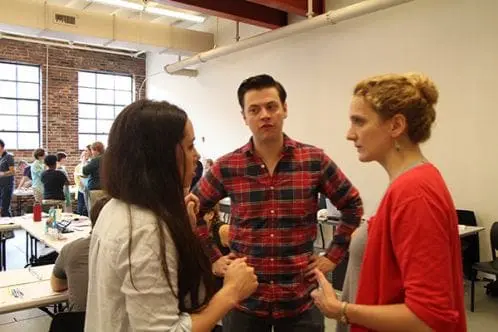
February 23rd, 2010We have arrived in the world of “our Verona” Our set is simple and our lights are rich. We are in the process of coloring in the lines and the moments of the work we have sketched in, to tell this story. It is the hardest part of working on this show so far… waiting to experience it with all of the technical elements in place.
Like Father Like Son
February 22nd, 2010
by Mark Kennedy, Arden Professional Apprentice
I always think about my father when I work on Blue Door. Whether it’s ironing Kes Khemnu’s stubbornly wrinkled pants, or focusing the lights in Thom Weaver’s design, or chatting up and helping out the Freedom Theatre folk during the Pay What You Can performance, no matter what the task is, my father pops into my head.
My father is a pediatrician with an infectious disease specialty. Always curious. Always learning. Studying for new tests even though he’s worked thirty plus years in his field. Commuting two hours each way to work in a hospital where he gets to treat kids, teach, and research all together. Spending weeks on call, taking consult after consult. Traveling to South Korea to work on the meningitis vaccine. Traveling to Africa to serve as a medical missionary. My father is determined, passionate, and works very, very hard.
Growing up I didn’t understand why my father wasn’t around as much as I wanted him to be. He was always at the hospital, always caring for other people’s children, and I used to think he just didn’t like me, that he cared more about his job than his family. Even in high school, as much as I was interested in science, I chose to focus on the arts, and we began to speak different languages. Platelets to plays.
He was also a hardcore swimmer growing up. Thanks to him, I swam competitively for ten years, and worked my brains out trying to balance swimming, theatre, and school. For a while I enjoyed it all, but by my senior year of high school the pressure of getting scholarships and best times overwhelmed me, and in spite of my father’s extra weight training sessions and personal pep talks, I quit the swim team to play Ernst Ludwig in our high school production of Cabaret. I told my parents I was unhappy swimming, I needed to focus on what I loved, and they listened. I could tell my father was still a little disappointed.
See, he has his own swimming story. When Dad was my age, he slipped a disc in his spine at a swim meet. He was told by his doctor that he would never swim again, but Dad, clearly already thinking he was a doctor, disagreed, and worked out in the pool for however little he could for months on end until he actually rehabilitated his back and was able to compete again. He did the work, all by himself, and actually healed himself.
Now, whenever I work on Blue Door, watching Lewis struggle with the stories of his father and their fathers, I notice how much we inherit from our past. I notice how all the jobs I do in this apprenticeship inherently involve the things my father values most. Working with people. Learning new skills. Diagnosing problems, coming up with solutions. And, above all else, doing hard work, even in the face of the impossible. I think about how I couldn’t have the endurance to do half this job without my training as a swimmer, and I wouldn’t have the support, emotional or financial, to pull it off without my dear old Dad.
His hard work, his love, really, keeps working on me. And this play keeps working on me, too.