
The Story Behind Our Audience Ask Buttons

Amelia Kovach, Arden Apprentice Class 31, with “Measure your Life in Love” Button (Rent, 2025)
I, for one, love the Audience Ask Button. It’s a chance to take a little piece of the show home with you.
Before I joined the team as an Arden Professional Apprentice, I donated during the Audience Ask and received my very own pin. Now that I work here, I’m even more of a fan. Holding the audience ask basket after a performance gives me the chance to connect with patrons, hear what they thought about the play, and share favorite moments from the production together.
Around the Arden, collections of these buttons seem to appear everywhere—pinned to bulletin boards, tucked into desk drawers, scattered around the green room. Seeing all of them made me wonder: how did this tradition begin, and how far back does it go?
So, I sat down with Arden’s founders to learn more about the history behind one of my favorite Arden traditions.
Small Button with a Big Story

Jonathan Silver, Associate Artistic Director, with the Arden’s Audience Ask Button Archive
For those unfamiliar with the Audience Ask, here’s how it works: after the show, members of the cast invite audience members to make a donation as they exit the theatre. In return, patrons receive a custom-designed button created specifically for that production.
According to Producing Artistic Director Terry Nolen, the Audience Ask itself began years ago as a way to directly connect audiences to the work happening both onstage and beyond it.
“After the show, cast members turn to the audience and say, ‘This is what we do. We have to raise a lot of money to create the work you’re seeing here. We also do work in schools and communities that you may not know about. If you’d be willing to make a gift, we’d really appreciate it.’”
But the buttons themselves? Their origin story goes back even further.

One of Ed Robins’s Upper Darby Summer Stage Buttons (Annie, 1984)
Managing Director Amy Murphy traces the tradition all the way back to the summer of 1984.
“When we were in college, I went back and I was on staff at Upper Darby Summer Stage. Terry Nolen was my boss. Terry’s Assistant Director was a guy named Ed Robins, who I had been dance partners with all growing up. He always made buttons for every show. Everyone commented on them. He’d sit at home with his button maker and make these things himself. I had a bunch of them.”
Terry added that Ed originally created the pins as gifts for cast members—tangible keepsakes from an art form that disappears once the curtain comes down.
“Playwright Michael Hollinger talks about theatre as an ephemeral art form,” Terry said. “Ed’s buttons gave us all something concrete to remember.”
“Art Isn’t Easy”
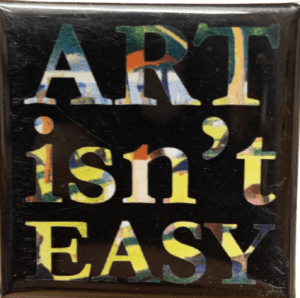
“Art isn’t Easy” Button (Sunday in the Park with George, 1994)
The tradition officially entered the Arden’s history in 1994 during a production of Sondheim’s Sunday in the Park with George.
“We made these ‘Art Isn’t Easy’ buttons,” Amy said. “And that’s really how the buttons started here.”
What surprised them most was how quickly the buttons began traveling beyond the Arden’s walls.
“A month later,” Terry remembered, “I walked into a major funder’s office and saw the button pinned to their bulletin board.”
That visibility was intentional. The buttons weren’t just souvenirs—they were conversation starters.
“If you see a button that says ‘Art Isn’t Easy,’ you ask, ‘What’s that?’” Amy explained. “And then someone tells you about the show they saw at the Arden.”
Of course, there was also a little bit of ‘90s fashion involved.
“Realize how young we were,” Amy laughed. “You know, we were all in jeans, wearing jean jackets, and we were wearing buttons all over our jean jackets.”
Designing a Keepsake

Clayton Tejada, General Manager, with “Humble” Button (Charlotte’s Web, 2023)
If you’ve attended productions here over the years, you’ve probably noticed that each button is distinct. Some feature quotes, others imagery, and many become instantly tied to a specific show in patrons’ memories.
“We want it to speak to the production,” Terry said. “If it’s not just the title, then what is the thing that makes this show special? We try to create something that feels like a memorable keepsake.”
That sense of connection is exactly what makes the Audience Ask so meaningful. The buttons may be small, but they represent something much larger: a community supporting the work together.
Every Little Bit Helps

Nick Hatcher, Artistic Assistant, with “Why We Tell the Story” Button (Once on This Island, 2024)
The Audience Ask invites participation at every level. Some patrons drop spare change into the basket. Others give more substantial donations by check, card, and now even Venmo. Every contribution matters.
“We offer the pin if you give at least $20,” Amy explained. “We raise something like $20,000-$35,000 from Audience Asks,” she said. “People may not realize the impact they’re part of when they drop cash into the basket, but every little bit truly helps.” Those contributions add up in a major way.
That support has become increasingly important as funding landscapes continue to shift.

TJ Harris, Marketing and Group Sales Associate, with “Gotta Have a Gimmick” Button (Gypsy, 2017)
“Individual giving is the bedrock of our support, especially as government and other funding priorities have changed” Terry shared. “Some people have been giving for years. Some donate once. The fact that so many individuals have stepped up and contributed is incredibly powerful. And not only does it financially allow us to do what we do, but it also inspires us to do what we do. So, we’re deeply grateful.”
And that work extends far beyond the stage.
“Because of your contributions,” Amy said, “we’re able to go into schools. We’re able to support Philadelphia’s artist community. That’s what this whole button thing means to us.”
A Tradition That Continues

Tylar Benedetto, Development Coordinator, with “A-R-D-E-N” Button (The 25th Annual Putnam County Spelling Bee, 2023)
What began with one person, a button maker, and a handful of handmade pins has become a beloved part of the Arden theatergoing experience—a tradition rooted in connection, community, and a collection of quirky pins.
“The tradition keeps it local,” Amy reflected. “Dug-in. A foundation with roots in the ground. We’re about keeping it going for generations.”
And honestly? I think that’s my favorite part. Every button tells the story of a show. But together, they also tell the story of the people who make this theatre possible. Many minds have come together to make the buttons over the years. Lately, that has been Tylar Benedetto’s responsibility. She’s pictured left with the first button she designed.
 “It takes our community to continue the work that we do” Tylar says. “And donating to Audience Ask has a direct and immediate impact on the work. Thank you!”
You can get the Arden’s latest pin by making a $20 donation when you go see Dear Evan Hansen. Thank you for supporting great stories told live on stage and thank you for being part of the Arden Family.